|
DAY 3
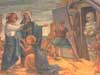 Early
on Sunday morning we started our visit to Bethany after prayer. In
preparation for the visit, we read John 11 and a prayer was said followed by
a song. Bethany lies 3 Kms to the east of Jerusalem on the eastern slope of the
Mount of Olives on the road to Jericho. This village, renamed since 4th
century, carries the name of the Lazarus. El Azariyeh, was the home of
Lazarus and his two sisters Mary & Martha. Here Mary anointed Jesus with
precious perfume (Mathew 26:1-13). Here Christ performed the miracle of
raising Lazarus from the dead (John 11:1-44). We descended down a flight of
25 steps to a cavern that was Lazarus’ tomb before he was raised from the
dead by Jesus. Early
on Sunday morning we started our visit to Bethany after prayer. In
preparation for the visit, we read John 11 and a prayer was said followed by
a song. Bethany lies 3 Kms to the east of Jerusalem on the eastern slope of the
Mount of Olives on the road to Jericho. This village, renamed since 4th
century, carries the name of the Lazarus. El Azariyeh, was the home of
Lazarus and his two sisters Mary & Martha. Here Mary anointed Jesus with
precious perfume (Mathew 26:1-13). Here Christ performed the miracle of
raising Lazarus from the dead (John 11:1-44). We descended down a flight of
25 steps to a cavern that was Lazarus’ tomb before he was raised from the
dead by Jesus.
[Slide show - Bethany]
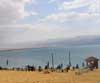 We left Bethany and went down to the Dead Sea. The Dead Sea is
75 Kms
long and 16 Kms wide. Four hundred meters below sea level, it is called Dead
Sea because of the absence of any form of life in its waters. Its water is We left Bethany and went down to the Dead Sea. The Dead Sea is
75 Kms
long and 16 Kms wide. Four hundred meters below sea level, it is called Dead
Sea because of the absence of any form of life in its waters. Its water is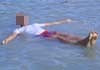 saturated with salt and minerals; every liter of water contains 250 grams of
minerals. Its specific gravity is 1.166, which allows us to float with very
little effort and one can thus relax in the water. The clayey mud found in
the sea bed is said to be a very good skin conditioner. Many collected the
mud and some stones from the sea.
saturated with salt and minerals; every liter of water contains 250 grams of
minerals. Its specific gravity is 1.166, which allows us to float with very
little effort and one can thus relax in the water. The clayey mud found in
the sea bed is said to be a very good skin conditioner. Many collected the
mud and some stones from the sea.
[Slide show - Dead Sea]
After a good break on the shores of the Dead Sea, we drove back towards
Jerusalem.
 On the way we were able to see St. Martyr’s Monarchy Hebrew
University on Mount Scopus On the way we were able to see St. Martyr’s Monarchy Hebrew
University on Mount Scopus
 with the Hadassa University Hospital to the
right. Our next stop was St. Ann’s church. When the crusaders were driven
out of Jerusalem they left behind 30 churches. Most of these churches were
totally destroyed. St. Anne’s church is one of the churches that escaped
destruction and is the best preserved among them. This church was built in
the Romanesque style in 1100 AD. It is built over an area venerated as the
birthplace of Mary. Adjacent to this church are the vast remains of the pool with the Hadassa University Hospital to the
right. Our next stop was St. Ann’s church. When the crusaders were driven
out of Jerusalem they left behind 30 churches. Most of these churches were
totally destroyed. St. Anne’s church is one of the churches that escaped
destruction and is the best preserved among them. This church was built in
the Romanesque style in 1100 AD. It is built over an area venerated as the
birthplace of Mary. Adjacent to this church are the vast remains of the pool
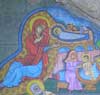 of Bethesda. It lies a few yards from St. Stephen gate inside of Bethesda. It lies a few yards from St. Stephen gate inside
 the wall of
Jerusalem. It stood near the Sheep Gate, which led to the temple. Here Jesus
healed the man who was crippled for 38 years. It is rectangular in shape 105
meters long, 60 meters wide and 8 meters deep. It was buried under debris for
hundreds of years. We then proceeded to visit Yad Vashem or the Holocaust
Museum. This museum has a great collection of objects and images from the
days of Hitler and his torturing of Jews during the Second World War. the wall of
Jerusalem. It stood near the Sheep Gate, which led to the temple. Here Jesus
healed the man who was crippled for 38 years. It is rectangular in shape 105
meters long, 60 meters wide and 8 meters deep. It was buried under debris for
hundreds of years. We then proceeded to visit Yad Vashem or the Holocaust
Museum. This museum has a great collection of objects and images from the
days of Hitler and his torturing of Jews during the Second World War.
[Slide show - Shops, More views of Jerusalem, St.
Ann's Church, Bethesda, Museum]
We then proceeded to visit the Holy Sepulcher
traditionally deemed the site of Jesus Christ’s crucifixion and the tomb of
Jesus. The Via Dolorosa or “Way of Sorrow” winding along narrow streets of
Jerusalem’s Old City leads from the Ecce Homo Convent to the Basilica of the
Holy Sepulcher.
 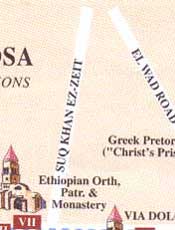 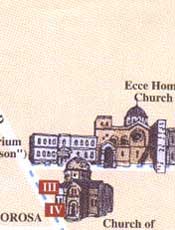 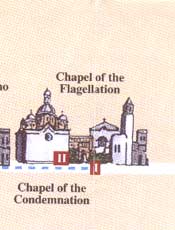
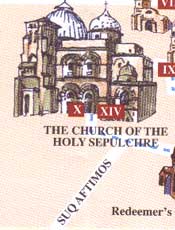 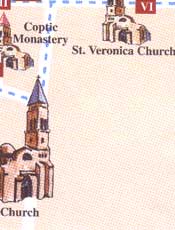  
Rain did not deter our taking the traditional
route Jesus followed bearing His Cross from Pilate’s Judgment Hall in the
Antonia, to Calvary Hill or Golgotha the site of the crucifixion. Along this
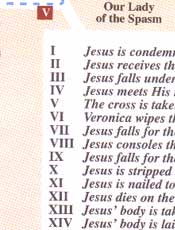
route are the “14 stations of the cross”. Each station marks an event of
sacred memory, with chapels for reflection, convents and monasteries of
devotion, and the sacred basilica for commemoration – along Christendom’s
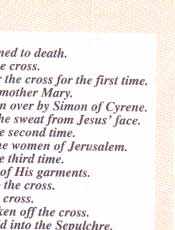
most hallowed road. The fourteen stations are:
|
Station 1 |
Jesus is condemned to death.
“Then they led Jesus from Caiaphas to the Praetorium (John 18:28)
Chapel of
Flagellation |
|
Station 2 |
Jesus takes up the Cross
“Pilate took Jesus and Scourged him” (John 19:1)“Then he handed Him over
to them to be crucified (Jn. 19:16)
Chapel of
Flagellation |
|
Station 3 |
Jesus falls under the Cross for the first time.
“He who would console me and give me back my life is far from me (Lam.
1:16)
Church of Our
Lady of the Spasm |
|
Station 4 |
Jesus meets His Mother
“All you who pass, look and see: is any sorrow like the sorrow that
afflicts me?” (Lam. 1:12)
Church of Our
Lady of the Spasm |
|
Station 5 |
Simon the Cyrenian is forced to carry the Cross
“They enlisted a passer-by, Simon of Cyrene, father of Alexander and
Rufus, who was coming in from the country, to carry His Cross” (Mark
15:21)
Along the way |
|
Station 6 |
Veronica wipes the sweat from Jesus’ face.
“May the Lord’s Face shine upon you (Num 6:25)
St. Veronica
Church |
|
Station 7 |
Jesus falls for the second time.
“With their affliction, He was afflicted. In His love and His pity He
redeemed them” (Is. 63:9)
Ethiopian
Orthodox Patriarchate and Monastery |
|
Station 8 |
Jesus consoles the women of Jerusalem.
“Daughters of Jerusalem, weep not over Me. Weep rather over yourselves
and your children. For if green wood is treated thus, how will the dry
wood be treated” (Luke 23:28)
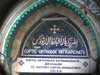
Coptic
Patriarchate |
|
Station 9 |
Jesus falls for the third time.
“I
have come to do your will, O God” (Ps. 40:8)
Coptic Monastery |
|
Station 10 |
Jesus is stripped of His garments.
“From the sole of the foot to the head, are bruises and sores and
bleeding wounds” (Is. 1:6) (The next Stations of the Cross are
within the Basilica.)
Church of
the Holy Sepulcher |
|
Station 11 |
Jesus is nailed to the Cross
“They have pierced my hands and my feet. They have numbered all my
bones” (Ps. 22)
Church of
the Holy Sepulcher |
|
Station 12 |
Jesus dies on the Cross
“Jésus cried, ‘Eli, Eli, lama sabachtani?’ My God, My God, why hast Thou
foresaken Me? One more, uttering a loud cry, Jesus gave up His spirit.
(Matt. 27:50)
Church of
the Holy Sepulcher |
|
Station 13 |
Jesus is taken down from the Cross
“Joseph of Arimathea, a member of the council, and a disciple of Jesus,
went to Pilate and asked for the body of Jesus. Then he took the body of
Jesus down” (Luke 25:53)
Church of
the Holy Sepulcher |
|
Station 14 |
Jesus is laid in the Tomb
“And when Joseph had taken the body, he wrapped it in a clean linen
cloth and laid it in his own new tomb which he had hewn out in the rock.
Then he rolled a stone before the entrance of the tomb.” (Matt. 27:59)
Church of
the Holy Sepulcher |
 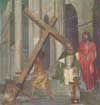 The church is divided
between 6 communities under a status quo decreed by the Turkish rulers in
1852. The Main Altar is Greek, ornamented in
Eastern style and stands over the Rock of Calvary. It is over the place
where the crosses of Jesus and the two thieves were erected. In the bed
rock, beneath is a large crack caused by the earthquake on the day Jesus The church is divided
between 6 communities under a status quo decreed by the Turkish rulers in
1852. The Main Altar is Greek, ornamented in
Eastern style and stands over the Rock of Calvary. It is over the place
where the crosses of Jesus and the two thieves were erected. In the bed
rock, beneath is a large crack caused by the earthquake on the day Jesus
 died.
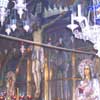
The
little altar between the main ones on
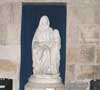
Calvary is adorned with a statue in wood, fashioned in the 16th
Century and sent from Lisbon in 1778. It recalls the grief of Mary and symbolizes the eternal grief of mothers at the death of their children. Though it was raining
heavily , we all walked through the 'Way of Cross' and died.
The
little altar between the main ones on
Calvary is adorned with a statue in wood, fashioned in the 16th
Century and sent from Lisbon in 1778. It recalls the grief of Mary and symbolizes the eternal grief of mothers at the death of their children. Though it was raining
heavily , we all walked through the 'Way of Cross' and
 it
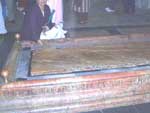
was a wonderful experience. Inside the Church we saw the Stone of the
Anointment where they put Jesus’ body after his death. We also had a chance
to touch the piece of rock (which is the piece of rolling stone kept to
close the entrance of the cave where Jesus was buried) placed beneath the
Altar at the 12th station of the Cross to Calvary. We all found
time to meditate and pray at the foot of the cross , where our Savior Lord
Jesus Christ was crucified for our sins and prayed at the tomb of our Lord ,
where he rose again for our salvation. it
was a wonderful experience. Inside the Church we saw the Stone of the
Anointment where they put Jesus’ body after his death. We also had a chance
to touch the piece of rock (which is the piece of rolling stone kept to
close the entrance of the cave where Jesus was buried) placed beneath the
Altar at the 12th station of the Cross to Calvary. We all found
time to meditate and pray at the foot of the cross , where our Savior Lord
Jesus Christ was crucified for our sins and prayed at the tomb of our Lord ,
where he rose again for our salvation.
[Slide show - Holy Sepulcher, Via Dolorosa]
This concluded
a very busy schedule that was a great spiritual blessing. |
